Home guide · Utah County
5 Things in Utah County Tap Water That Are Legal, But Not Exactly Healthy
Your water passes the law. But the law and the health guidelines are two very different lines.
Fill a glass at your kitchen sink. Hold it up to the light. It looks clean. It looks like nothing.
It is not nothing.
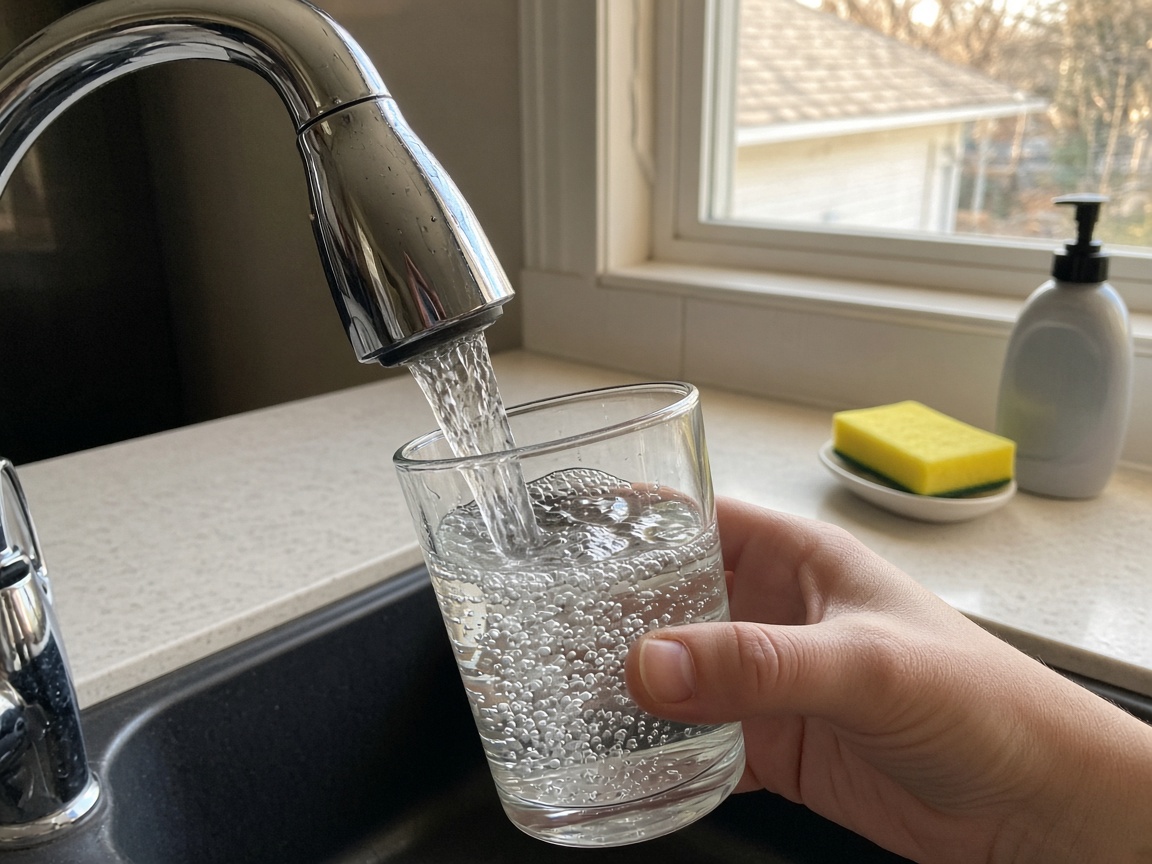
Every city has to test its water and post the results. It's called a Consumer Confidence Report. Most of us have never read one.
I read the ones for Provo, Orem and Lehi. Then I looked up the same cities in the EWG Tap Water Database. EWG is a health group that compares city water to stricter health guidelines, not just the legal limits.
First, the honest part
All of these cities meet the federal legal limits. Your water is legal.
But "legal" is a deal. It is set by what water plants can do and what it costs. A health guideline asks a different question: how much is low enough that it adds almost no risk over a lifetime?
Think of a speed limit. Going 79 on the freeway is legal. That doesn't mean it is the safest speed to drive your kids around. EWG points out that many legal limits have not been updated in almost 20 years.
1Chlorine, on purpose
Cities add chlorine to kill germs on the way through the pipes. That is a good thing. Nobody wants E. coli.
But the chlorine doesn't turn off when it reaches your house. Orem reports chlorine in its water at up to 1.3 parts per million. Lehi reports 0.2 to 0.8.
It's like bleach in a swimming pool. It keeps the pool clean. You still don't want to drink the pool. That "pool smell" from the tap? That's it.
2TTHMs: what chlorine makes
Here's the part most people never hear. Chlorine doesn't just kill germs. When it touches tiny bits of leaves and dirt left in the water, it makes new chemicals. These are called disinfection byproducts.
The biggest group is called TTHMs. Chloroform is one of them.
- Provo: 5.46 parts per billion. EWG's health guideline is 0.15. That's 36 times higher.
- Lehi: 5.68 parts per billion. That's 38 times the guideline.
- Orem's own report shows one test as high as 54.78 parts per billion.
The legal limit is 80, as a yearly average. So all of this is legal. EWG's guideline of 0.15 is the level it says adds about one cancer case per million people over a lifetime. EWG links TTHMs to bladder cancer and harm to a baby's growth.
It's like burning toast. The heat is fine. The black part it leaves behind is the problem.
3Haloacetic acids: more of the same
Chlorine makes a second family of byproducts too, called haloacetic acids.
- Provo: 3.98 parts per billion of one group (HAA9). EWG's guideline is 0.06. That's 66 times higher.
- Lehi: 4.1 parts per billion of another group (HAA5). That's 41 times EWG's guideline.
- Orem's report shows a high test of 32.6 parts per billion. The legal limit is 60.
In Provo's EWG listing, 9 of the 12 things over the health guidelines are chlorine byproducts.
4Arsenic, from the rock
Nobody puts this in. Our water runs through a lot of rock, and some rock has arsenic in it. The water picks it up on the way.
- Provo: 0.4 parts per billion. The health guideline is 0.004. That's 100 times higher.
- Lehi: 1.94 parts per billion. That's 484 times higher.
The legal limit is 10. The 0.004 guideline comes from California's public health goal for cancer risk. Again: legal, but far from the health line.
5The rock itself
This one you can see. Look at your faucet. That white crust is calcium and magnesium.
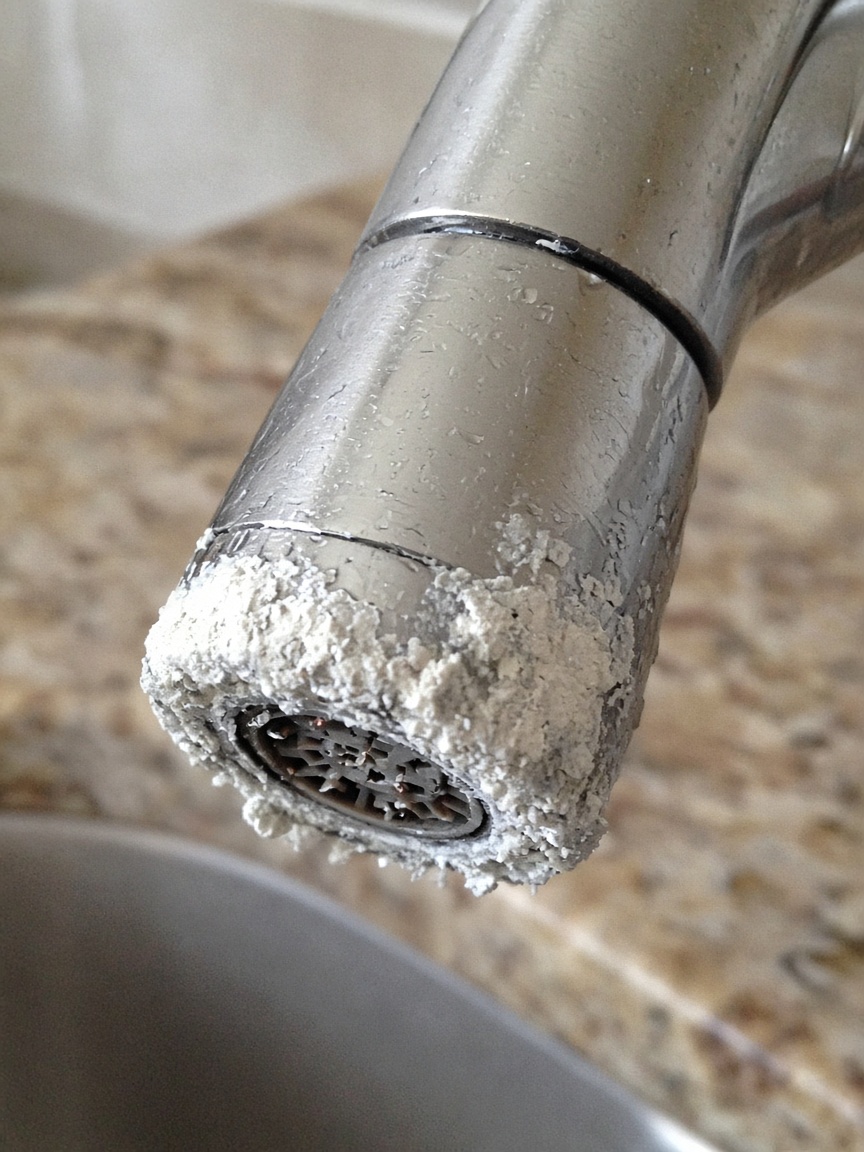
It's not a health risk. But it is hard on your house. Provo says its water is about 10 to 15 grains per gallon. Orem lists 7 to 25. The U.S. Geological Survey calls anything over about 10.5 "very hard." It crusts faucets, spots dishes and builds rock inside your water heater.
What about fluoride?
Utah passed a law that stopped cities from adding fluoride on May 7, 2025. Some water still has a little from nature. Orem's report shows 0 to 0.205 parts per million. So fluoride is not the big story here. The byproducts are.
You don't just drink it. You breathe it.
Most people think, "I'll buy a water pitcher. Done."
But think about your hot shower. Steam fills the room. Some of those chlorine byproducts, like chloroform, float up into that steam. You breathe them in. Your skin soaks some up, too.
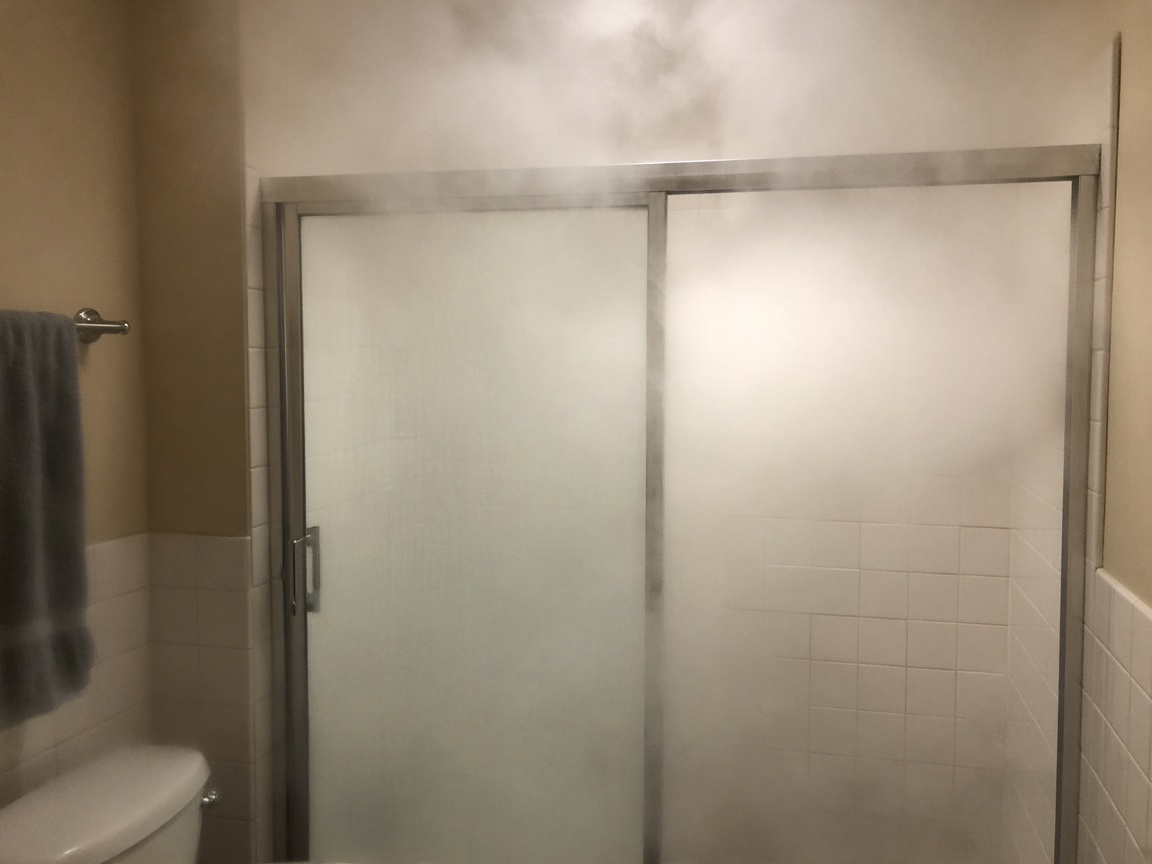
Scientists at Rutgers tested people's breath after normal showers. They found that the chloroform dose from one 10-minute shower was about the same as drinking tap water all day. Their skin took in about as much as their lungs.
Now think about your kids' bath. Warm water. Twenty minutes. Same water.
Why a pitcher can't win
A pitcher filter cleans one glass at a time. It does nothing for the shower, the bath, the ice maker, the pot of pasta or the dishwasher.
It's like putting sunscreen on one finger. Then going to the lake all day.
And the hard-water rock? A pitcher doesn't touch the rock going into your pipes and water heater.
Stop it at the door
Here's the big idea. Your house has one main pipe where water comes in. Every drop for every faucet, shower and bath goes through that one spot.
So you can chase the problem at 20 faucets. Or you can stop it once, at the door.
Think of muddy boots. You can scrub every carpet in the house. Or you can take the boots off at the front door.
Most of the time, that spot is in the garage, next to the water heater. Two tanks do two jobs:
- A whole-home carbon filter. Carbon works like a sponge for chemicals. It's one of the filter types EWG lists for chlorine and its byproducts.
- A water softener. Tiny beads grab the calcium and magnesium, so the rock never reaches your pipes.
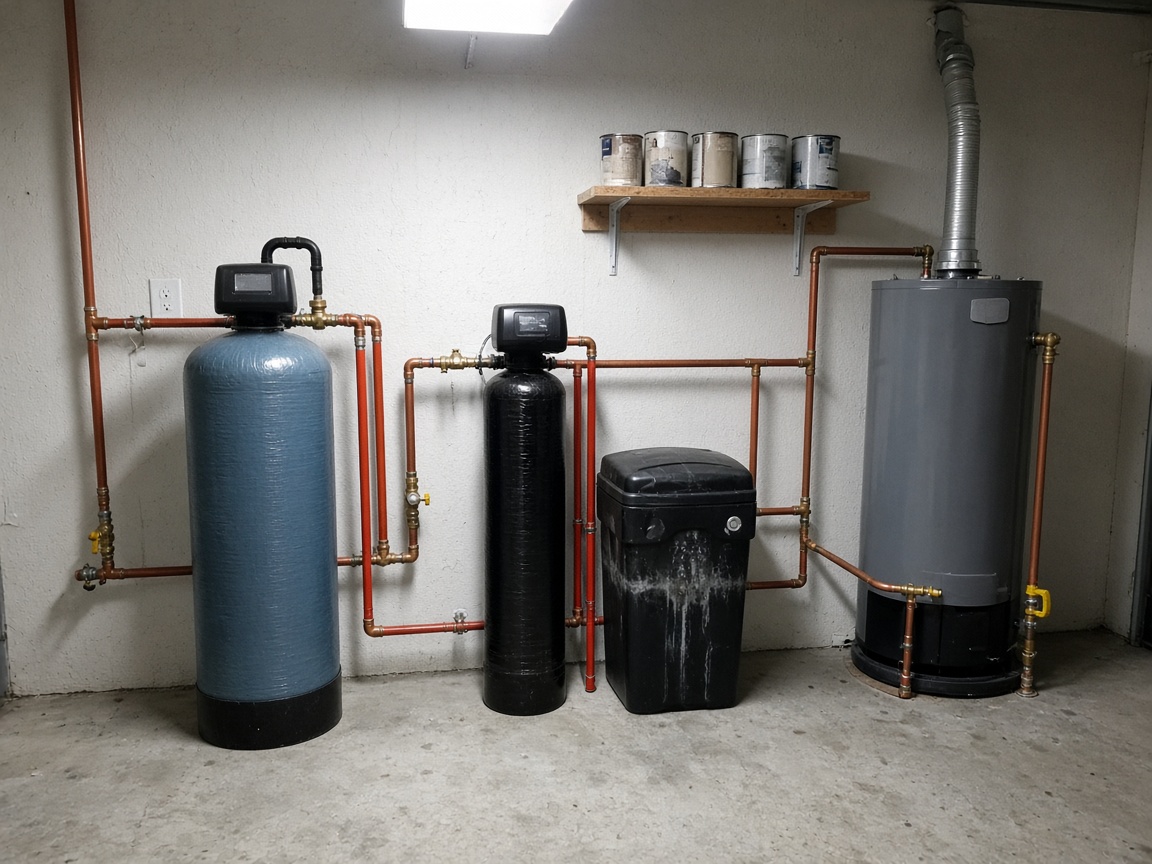
Some things, like arsenic, may need a different kind of filter. That's why the first step is not buying anything.
The first step: test your water
City reports are averages across a whole city. Your water comes through your own street and your own pipes. It can be different.
So before you buy anything, find out what is in your water. Then you can decide what makes sense for your home, if anything.
Get your free water test
Find out what is in the water at your home, not just your city's average. It takes about 30 seconds.
Sources: EWG Tap Water Database: Provo City (UTAH25006) and Lehi City (UTAH25015), data 2015–2023, accessed October 2026 (TTHMs, HAA5/HAA9, arsenic, count of contaminants over EWG guidelines; EWG health guideline definitions and "legal limits not updated in almost 20 years"); EWG, "EWG Standards for Drinking Water Contaminants" (TTHM guideline 0.15 ppb = one-in-a-million lifetime cancer risk; health effects). City of Orem 2026 Water Quality Report, data through 2025 (chlorine 0.05–1.3 mg/L; TTHM 0–54.78 µg/L; HAA5 0–32.6 µg/L; fluoride 0–0.205 mg/L). Lehi City 2025 Water Quality Report (chlorine 0.20–0.80 ppm; TTHM ND–25 ppb). Provo City 2025 Water Quality Report (hardness 10–15 gpg). U.S. Geological Survey, "Hardness of Water." Utah H.B. 81 (2025), Fluoride Amendments, effective May 7, 2025. Jo, Weisel & Lioy, "Chloroform Exposure and the Health Risk Associated with Multiple Uses of Chlorinated Tap Water," Risk Analysis (1990); Jo, Weisel & Lioy, "Routes of Chloroform Exposure and Body Burden from Showering with Chlorinated Tap Water," Risk Analysis (1990). EPA legal limits (MCLs): TTHM 80 ppb, HAA5 60 ppb, arsenic 10 ppb. All cities listed were in compliance with federal standards in the reports cited. EWG guidelines are voluntary health benchmarks, not legal limits.
A Utah County homeowner guide